U.S. Hyperscale Investment Shifts Decisively Inland
RENO, NV, April 13, 2026
New data from Synergy shows that the focus of US hyperscale developments has shifted substantially away from coastal regions and towards the center of the country, with Texas and Midwestern states being the main beneficiaries. At the end of 2025, Texas and the Midwest accounted for 33% of operational US hyperscale data center capacity, while Synergy's pipeline of future hyperscale data centers shows that they will account for 53% of new capacity coming online over the next few years. Northern Virginia has, and will continue to have, the single biggest concentration of data centers, but as AI has supercharged investment in infrastructure, the geographic focus has moved more inland, seeking out areas where power is more readily available. By a wide margin Texas is the most prominent state in the pipeline. In the Midwest, Wisconsin, Indiana, Michigan and Missouri will all grow rapidly in importance, as they have attracted multiple major projects from Amazon, Google, Meta, Microsoft, OpenAI and CoreWeave.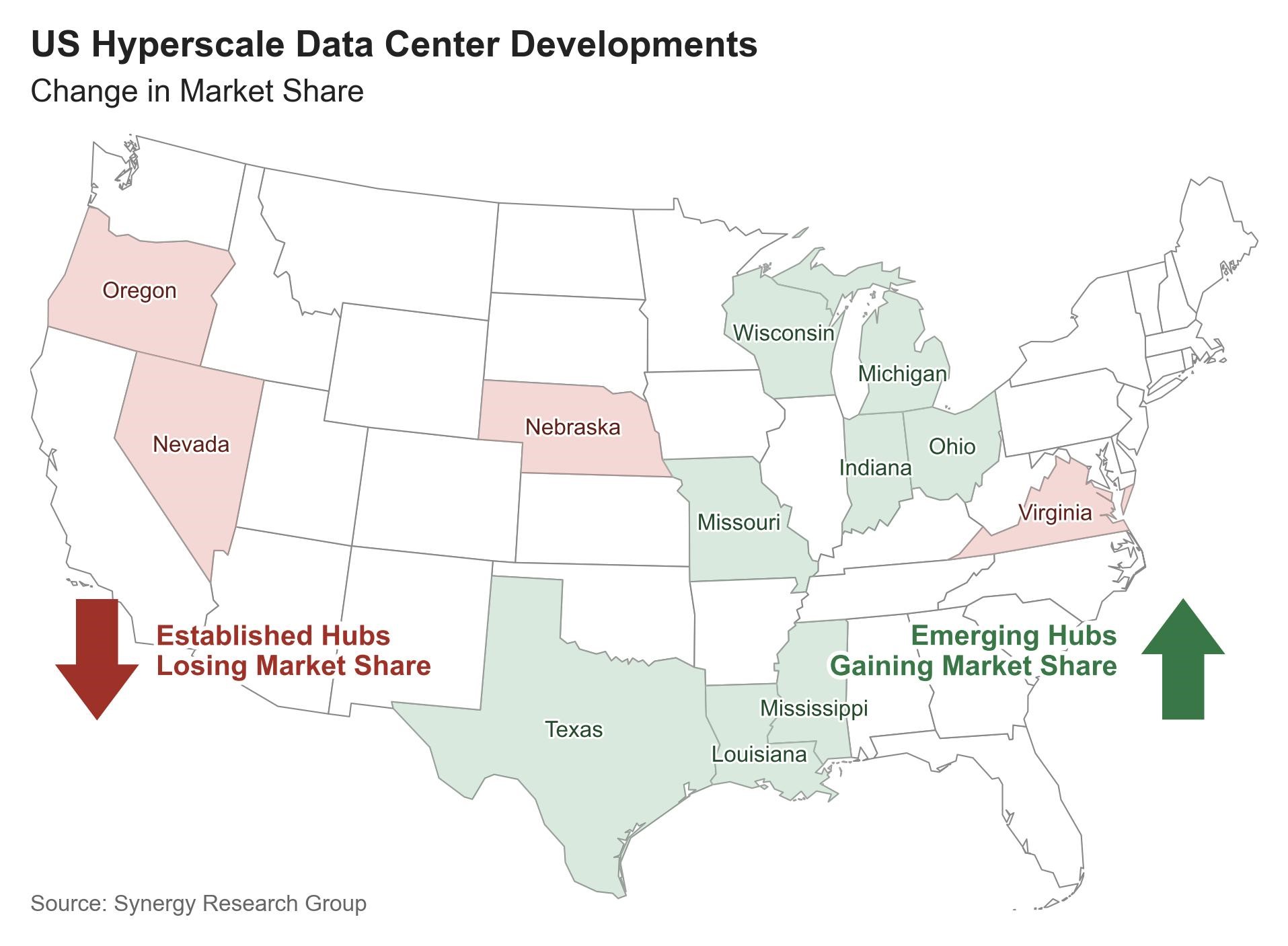 The research is based on an analysis of the data center footprint and future plans of 21 of the world’s major cloud and internet service firms, including the largest operators in SaaS, IaaS, PaaS, search, social networking, e-commerce and gaming. Together they had 1,360 operational hyperscale data centers at the end of 2025, of which 580 are in the US. Synergy's known pipeline of future hyperscale data centers has another 803 data centers that will come online in the next few years, of which 437 are in the US. While there are more operational data centers than there are in the pipeline, the pipeline actually has a bigger overall capacity, reflecting the fact that hyperscale data centers have continued to increase in size in terms of their IT capacity. The companies with the broadest data center footprint are the leading cloud providers – Amazon, Microsoft and Google. In addition to a huge data center footprint in their home US market, each also has multiple data centers in many other countries around the world. In aggregate the three now account for 58% of all hyperscale data center capacity. They are followed in the ranking by Meta, Alibaba, Tencent, Oracle, Apple, ByteDance and then other relatively smaller hyperscale operators.
“As infrastructure constraints intensify and market dynamics continue to shift, hyperscale providers are increasingly reallocating capital toward central U.S. regions, with Texas emerging as the primary focal point,” said John Dinsdale, Chief Analyst at Synergy Research Group. “A new wave of gigawatt-scale campuses is taking shape in non-traditional locations such as Abilene, Mount Pleasant, South Bend, El Paso, Boone County, and Kansas City. While established hubs will remain strategically important, the center of gravity for new hyperscale investment is clearly moving elsewhere.”
About Synergy Research Group
Synergy Research Group, now part of TechInsights, delivers quarterly analyses of global IT and Cloud markets, offering detailed breakouts of vendor revenues and shipments by segment and region. Market shares and forecasts are provided through Synergy Interactive Analysis (SIA™) — the industry's only fully proprietary SaaS platform purpose-built for market share and forecasting analytics.
For more than 25 years, Synergy has been a trusted source of quantitative research and market intelligence across emerging communications and technology sectors. By combining syndicated research with specialized consulting, we deliver actionable intelligence to marketing and strategy executives worldwide.
A trusted source of accurate market data, Synergy is cited by industry leaders as well as leading financial, business, and trade publications such as The Economist, The New York Times, The Wall Street Journal, United States Federal Reserve Board, NPR, Forbes, Bloomberg, Financial Times, Bank of England, Fortune, and The Guardian.











About TechInsights
Regarded as the most trusted source of actionable, in-depth intelligence related to semiconductor innovation and surrounding markets, TechInsights’ content informs decision makers and professionals whose success depends on accurate knowledge of the semiconductor industry—past, present, or future.
Over 650 companies and 100,000 users access the TechInsights Platform, the world’s largest vertically integrated collection of unmatched reverse engineering, teardown, and market analysis in the semiconductor industry. This collection includes detailed circuit analysis, imagery, semiconductor process flows, device teardowns, illustrations, costing and pricing information, forecasts, market analysis, and expert commentary. TechInsights’ customers include the most successful technology companies who rely on TechInsights’ analysis to make informed business, design, and product decisions faster and with greater confidence. For more information, visit www.techinsights.com.
Subscriptions: sales@srgresearch.com
Press inquiries: heather.gallo@techinsights.com